Slavica is a mother of two and a woman who endured decades of domestic violence — physical, psychological, and economic. For thirty-five years she lived in a marriage marked by control, humiliation, and fear. She worked, but never had access to her own money. Her everyday life was a struggle — for dignity, for peace, for survival.
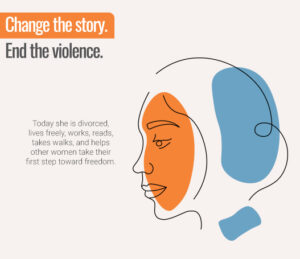
Despite the deep trauma, today Slavica lives freely. She works, takes care of herself, reads, walks, and helps other women take their first step toward freedom.
Here’s the full editorial translated into English, keeping the narrative flow, emotional tone, and structure intact:
WHEN FEAR IS EVERYDAY LIFE
“When we heard the car arriving, my children and I would lie down and pretend to be asleep. Just so we wouldn’t provoke his anger.” This habit was not a matter of choice — it was shaped as an instinct for survival. When life is wrapped in fear, the body and mind don’t seek freedom, they seek a way to endure that fear. For years, Slavica lived in a state where every day was a battle with invisible threats, and every moment — a potential danger. Her life was reduced to silence. Not to provoke. Not to stand out. Not to be a reason for anger. Each day was a strategy — of invisibility, restraint, survival.
But the violence was not only physical. Her husband controlled every single coin. “I never had money on me. The bank card was always with him. If I needed to go to the doctor, he would give me 200 denars ‘just in case’.” Slavica worked, but never had access to her own salary. For food, for medicine, even to see a doctor — she had to ask. Financial control was constant and deeply humiliating. “I often had to put things on credit at the store just to cook lunch, and when he paid the bill with my salary, he would bring it home — only to show me how ‘much I spend’.”
RECOGNITION
One day, while at work, a local NGO held a workshop on domestic violence. Slavica attended and listened to different stories. “It was as if I recognized myself in their stories,” she says.
After the workshop, she started a conversation with one of the women. Her words were a message that something had to change:
“Life is a struggle. We must fight for ourselves, no one else can do it for us. Nothing is handed to us on a silver platter.”
The workshop opened her eyes. For the first time, Slavica recognized herself in others’ stories — in the silence, in the fear, in the daily battle she had been fighting without words. And that was the moment she decided to leave. She took only one bag of clothes and her daughter. At first, she found shelter with her sister.
The decision to divorce was not yet final. Slavica hesitated, wondering if divorce was the right solution. She believed that maybe he would change, admit his mistakes. “Because of the children and the family business we had, we occasionally communicated. Sometimes he seemed sincere, but quickly returned to the old ways. I realized that the more I tried, the more I sank into quicksand.”
The children, trying to preserve something of their own, returned to live in the old house. But one night, drunk, their father threw them out too. In the middle of the night. “That was the last straw. That was when my last hope that he would change died.”
This was the moment that broke the illusion — when Slavica stopped searching for excuses, stopped hoping, and finally acknowledged the violence as something that would not disappear. “This time I did not hesitate. I filed for divorce.”
AND YOU CAN TOO
After filing for divorce, Slavica received psychological, legal, and emotional support from the NGO. “They welcomed me with warmth and understanding. It was the first time someone listened to me without interrupting,” she says.
The meeting with the team and the simple but decisive words “you can” restored her belief that it was worth fighting — for herself, for her rights, for her life. Psychological support helped her regain self-confidence, while economic independence gave her a sense of control. “For me, that is peace,” Slavica says. “To be able to decide for myself what to buy, where to go — without begging.”
THERE’S NO PLACE LIKE HOME
Her sister’s home was the first refuge — safe, but temporary. The true feeling of “home” came two months later, when Slavica rented her own apartment. The space was modest, almost empty, but it was hers. “I felt both fear and joy. I felt like I could finally breathe,” she says. “When we hung the first curtain and cooked the first meal, I felt at home, even though we had only a few things.”
That small apartment, with just a few pieces of furniture, became her world. A space she chose, arranged, and owned. No rules imposed by others, no fear. For the first time, Slavica didn’t have to beg, explain, or justify herself. Every object was her choice.
DIVORCE IS THE BEGINNING
Divorce was not the end. For Slavica, it was the beginning. Although she still faces a court case over property division, today she lives with peace in her soul. “I cried, but it was a different kind of cry — as if I was releasing all the weight from inside me,” she says.
The feeling of safety came gradually, through everyday, simple moments. Buying something for herself without explaining. Reading a book without being interrupted. Watching a movie without fearing the sound of a key in the lock. Drinking coffee where silence was no longer a threat, but serenity. “Home now means peace, silence, and security. A place where I can be who I am.”
Today, Slavica is a symbol of women’s strength. She is in contact with other women who are going through similar experiences. She gives them hope, speaks honestly, without embellishment. “I tell them it can be different — because I am living proof of that.”