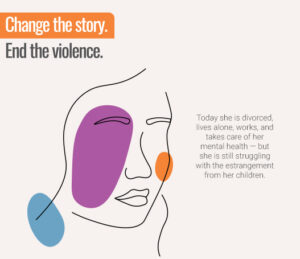
In North Macedonia, there are still women who, due to fear, stigma, or institutional barriers, fail to seek help in time and spend years living in silence as victims of domestic violence. This is the story of Snezhana, a 40-year-old general practitioner and mother of two, who lived in an abusive relationship for many years, subjected to physical and psychological abuse.
Although professionally active, her private life was marked by control and threats. Her struggle continues — but the violence is behind her.
JEALOUSY IS NOT LOVE
In many cases of domestic violence, control begins with jealousy. Professionally active women often face partners who perceive their success as a threat. Instead of support, they receive restrictions. Instead of partnership — surveillance. Violence doesn’t always end in bruises, but it always leaves consequences. “He was painfully jealous. Because of him, I didn’t pursue specialization. He gave me an ultimatum: either the family or the career,” says Snezhana. That was the initial pressure — to choose between personal growth and ‘peace at home.’
POSTPONEMENT DOESN’T MEAN ACCEPTANCE
Like many other women, Snezhana stayed in the marriage not because she didn’t recognize what was happening, but because when you’re a mother, the decision to leave isn’t just personal — it’s logistical, financial, emotional. “My mother passed away, and my father was emotionally distant since early childhood,” she admits.
That emotional and practical void delayed her decision to divorce. “Maybe because of my mother’s death, I postponed the divorce for many years, knowing I wouldn’t have help with the children,” Snezhana shares openly.
The lack of care from her father during childhood left a mark that easily spilled into her marriage. When you haven’t learned what emotional safety means, it’s easy to accept the absence of closeness as normal.
SUPPORT DOESN’T HAVE TO BE BIG — IT JUST HAS TO BE REAL
“I started falling into depression, staring at one spot for hours. I lost 20 kilos in a very short time,” she says. The psychological abuse had already damaged her health and identity. Going to therapy was a turning point — the moment she first spoke about her problems and felt relief.
When she finally decided to stop the violence, support came from her friends and colleagues. “In the first few days, they sent me household items and bed sheets. That was enough to start over,” she says. She didn’t receive significant support from her family, but she had her own apartment — and that was crucial. She had somewhere to go, and somewhere to begin again.
STIGMA DOESN’T END WITH DIVORCE
In small communities, divorce is still seen as personal failure rather than courage. Women who leave violent relationships face a new form of isolation — from friends, neighbors, even institutions.
“It bothered me that people immediately looked at me differently,” says Snezhana. “I needed a plumber, but he refused to come to my home so my ex-husband wouldn’t get the wrong idea, or the neighbors wouldn’t gossip.”
Many advised her to stay in the marriage for the sake of the children, which made her feel even worse.
In small towns, she says, divorce is especially hard to overcome. “I still feel unwelcome. At the gym I started going to, and in cafés, there are always nasty comments and remarks that make me feel uncomfortable.”
The stigma spread into her private relationships — a close friend stopped communicating after her husband told her not to associate with divorced women. The school also failed to ensure equal communication after the father requested that they contact only him.
THE GREATEST PAIN IS THE DISTANCE FROM HER CHILDREN
Snezhana overcame her depression with professional help, but her struggle continues. The violence is behind her, but what still causes her the most pain is the distance between her children. In their case, the father has custody, and although the agreement allows for regular communication, it doesn’t happen.
“What hurts the most is that my children avoid me and don’t want to talk to me. I’m an alienated parent,” says Snezhana. “If they were younger, they would be brought to the social work center for visitation. But now that they’re older, there’s no mechanism through which I can reestablish that connection.”
Snezhana’s story is a reminder that these battles don’t end with divorce. Her experience shows that surviving doesn’t mean fully healing. That’s why it’s crucial for the system to respond timely and responsibly — to provide mechanisms for communication, protection, and psychological support. “People need to understand that violence — psychological and physical — isn’t a movie to watch. It’s something to act against, because it can happen to anyone,” Snezhana urges.