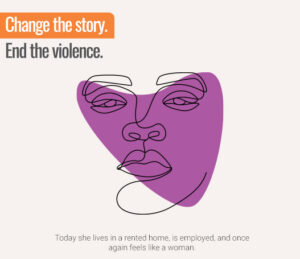
Lejla is a mother of two and a survivor of domestic violence. After 17 years marked by fear, threats, and pain, she managed to leave her abuser and begin a new life. Despite years of trauma, illness, and institutional barriers, she fought for divorce, custody, and safety—for herself and her children.
With support from a psychologist, friends, and institutions, she now lives in a rented home, is employed, and feels like a woman again.
SILENCE IS NOT GOLD
Lejla married young. She was pregnant and hopeful that she would build a stable family. But immediately after the wedding, her husband was sent to prison for drug trafficking. She was left alone with a newborn, no income of her own, and parents struggling with health issues. “I kept quiet about so many things and even lied—just so I wouldn’t be a burden. I didn’t want to worry them even more,” she recalls.
After three difficult years, her husband returned from prison. She thought the worst was behind her. “I hoped he would calm down, that we could start over. But I was wrong—that’s when the real ordeal began.” The violence was constant—physical, psychological, economic. “He hit me, insulted me, accused me of cheating, said our daughter wasn’t his. He forced me to take a DNA test to prove it.” Her parents found out, but couldn’t protect her. He threatened them too.
“I was afraid for everyone. The children grew up in fear. My son developed diabetes. The money I earned was never enough—he took it for drugs. If I didn’t give it to him, the horror would begin.” In an attempt to protect her children, she agreed to move abroad.
WHEN THE BODY SAYS “NO”
After years of silence and constant exposure to violence—years of trauma and fear—the suppressed emotions began to leave a mark. Psoriasis was the first sign. Then came the diagnosis: cancer. “I watched my body fall apart. Things got so bad that I sought help at the Dermatology Clinic in Skopje. That’s where they diagnosed me with cancer.”
Facing death head-on, she realized there was no more time to wait. The cancer diagnosis was another blow—but also a signal. Chemotherapy was brutal. Her hair fell out, her body changed, but that physical transformation triggered a psychological one. “I watched myself change and thought—now it’s time to change from within. To stop enduring.” That was the moment she began to believe she could succeed. Not just survive, but break free—from him and from that life. “If I can beat the illness, I can face this too,” she says.
THE STRENGTH TO CHANGE
In the beginning, institutions didn’t know how to help her. As she says herself: “I acted like an unstable person. I filed reports 16 times—and withdrew them each time. I was scared, hopeful, uncertain. They looked at me like I didn’t know what I wanted.” But real change began when she decided to fight back. “If we want real help, we first have to find the courage. It starts with us.”
Her greatest source of strength was psychological support. “The counseling, the guidance I received from my psychologist helped me understand that I wasn’t to blame for the violence. The only one responsible was my husband—the abuser.” Her psychologist was available at all times. “Even when I was abroad, we spoke online. He helped me realize I wasn’t to blame. That I wasn’t alone.”
Later, she also received support from institutions. “The Ministry of Interior, the Public Prosecutor’s Office, and the Center for Social Work began to take my story more seriously.” It was proof that the system can respond—but it’s crucial for women to speak up in time and not hesitate.
A WOMAN WHO BELONGS TO HERSELF AGAIN
After 17 years of not recognizing her own face, today she sees herself again. “Now, after all this time, I care about how I look. I want to take care of myself—for me. The kids are surprised. They see me put together, without tears, without bloodshot eyes or dark circles. I’m proud of myself.” For her, success doesn’t mean status—it means peace. “To sleep peacefully, in silence. To laugh with your children. To invite a friend over without fearing how he’ll react.”
She works, rents her own place, and manages her responsibilities on her own. “I feel so much better. I do things when I choose to—not when someone orders me to, with insults and blows.” Her job brings financial security, but also space to breathe. “I leave the house, I spend time with other people. I don’t just think about problems anymore.”
Her goals are clear: to be stable, to teach her children values, to be a role model. “I want to be an example for my daughter—that violence should never be tolerated. And for my son—to know he has no right to raise a hand against a girl.”
Lejla’s story is the voice of many women—those who wait and stay silent, hoping the violence is just a phase. But no woman should believe in the power of silence. Silence is a trap. A woman must learn that the first slap is already too much. And that moment should mark the beginning of the end of the relationship or marriage. Her fight is personal—but also collective. “I fight, and I will keep fighting—for myself, for my children, for all women. Because together we are stronger. Because it’s easier when you know you’re not alone.”
This story is a reminder: every woman has the right to speak, to choose, to live without fear. And it’s a call to action: don’t wait. Say stop—on time. Begin a new chapter with peace, dignity, and strength.